| Graham Foundation for Advanced Studies in the Fine Arts |
|
P U B L I C P R O G R A M S
Graham Foundation Exhibition: Cecil Balmond: Solid Void Cecil Balmond has transformed the role of the engineer in contemporary architecture with his unorthodox and visionary approach that merges architecture and engineering. Born in Sri Lanka and trained as a civil engineer, Balmond is the deputy chairman of ARUP, which he joined in 1968. He founded the Advanced Geometry Unit (AGU) in 2000, a research based practice, which comprises of architects, artists, engineers and scientists, to pursue his interest in the genesis of form using numbers, music and mathematics as vital sources. Under Balmond’s direction, the AGU works to develop new typologies for known building programs, as seen in the Coimbra Footbridge, Mondego River, Portugal (2006), the office building Twist, London (2004), the Battersea Power Station Master Plan, London (1999-2007) and the Ranchi Cricket Stadium, India (2008). Since the early 1980s Balmond has collaborated with such important contemporary architects and artists working today as Toyo Ito, Anish Kapoor, Rem Koolhaas, Daniel Libeskind and Álvaro Siza. Balmond has introduced innovative structural concepts that have resulted in some of the most challenging buildings in the canon of contemporary architecture.
Recent Press for Solid Void:
Gallery Hours
UPCOMING TALKS We, the Unsigned: Dispatches from the U.S. Pavilion at the Venice Biennale Aaron Levy and Bill Menking in Conversation ![]() U.S. Pavilion at 11th Biennale di Venezia, courtesy of Into the Open: Positioning Practice
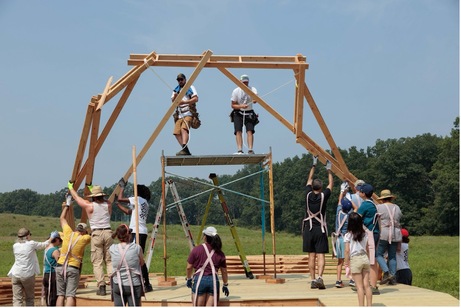
Thursday, March 26, 2009 Graham Foundation, Madlener House Due to space limitations, please RSVP to Katie Freeman at kfreeman@grahamfoundation.org or 312.787.4071, extension 226. Into the Open: Positioning Practice, the official U.S. pavilion at La Biennale di Venezia, the 11th International Architecture Exhibition, will be on view through May 1, 2009 at the Sheila C. Johnson Design Center at Parsons in New York City. The exhibition focuses on the increasing interest in civic engagement in American architectural practice, and examines the means by which a new generation of architects is reclaiming a role in shaping community and the built environment. For more information, visit www.labiennale.us. The exhibition features 16 architectural groups who actively engage communities, responding to social and environmental issues, including shifting demographics, changing geo-political boundaries, uneven economic development, and the explosion of urban migration. These intellectually entrepreneurial actors are designing the conditions from which new architectures can emerge-becoming activists, developers, facilitators of inclusive urban policies, as well as innovative urban researchers. Reaching creatively across institutions, agencies, and jurisdictions, they're negotiating hidden resources in the private, public, and non-profit sectors. Participants include: The Center for Land Use Interpretation (CLUI), Culver City, CACenter for Urban Pedagogy (CUP), New York, NY Design Corps, Raleigh, NC Detroit Collaborative Design Center, Detroit, MI The Edible Schoolyard/Yale Sustainable Food Project, Berkeley,CA and New Haven, CT Estudio Teddy Cruz, San Diego, CA Gans Studio, New York, NY The Heidelberg Project, Detroit, MI International Center for Urban Ecology, San Diego, CA Jonathan Kirschenfeld Associates, New York, NY Project Row Houses, Houston, TX Rebar, San Francisco, CA Rural Studio, Newbern, AL Spatial Information Design Lab/Laura Kurgan, New York, NY Studio 804, Lawrence, KS Smith and Others, San Diego, CA Into the Open: Positioning Practice, the U.S. pavilion at the 11th La Biennale di Venezia, received a major grant from the Graham Foundation in 2008. Aaron Levy is the Executive Director and Senior Curator of the Philadelphia-based Slought Foundation (http://slought.org), and teaches in the Department of English at the University of Pennsylvania. His international exhibitions and publications topically intervene in contemporary debates about art and architecture through an informal and collaborative approach. Projects include Cities Without Citizens at the Rosenbach Museum and Library (2003), Into the Open: Positioning Practice, the official U.S. representation at La Biennale di Venezia (2008), Theaters of Transparency at the Neue Galerie, Graz (2009), and Evasions of Power: On the Architecture of Adjustment (forthcoming, 2009). William Menking is the founder and editor of The Architect's Newspaper and is Professor, School of Architecture, Pratt Institute, Brooklyn. He has organized, curated and created catalogues for exhibitions on architecture for venues in the U.S. and Europe including: Archigram: Experimental Architecture 1961-1974, Superstudio Life Without Objects, FRAC Orleans: Experimental Architecture 1964-2000, and Into the Open: Positioning Practice, the official U.S. representation at La Biennale di Venezia (2008). He has co-authored an essay Total Living Unit: Joe Colombo and Architecture for the exhibition catalogue on Colombo for the Milan Triennale and organized a symposium on the architecture and video of Ant Farm. He organized and directed the New Practices series of lectures and exhibition at the AIA's New York Center for Architecture. Anselm Franke on Jimmie Durham ![]() Space, Jimmie Durham, 2002
Tuesday, February 24, 2009 The lecture considers Durham's critique of architecture and in particular the 'language of objects' deployed in his work. A key activist in the American Indian movement in the 1970s, Durham was Director of the International Indian Treaty Council and represented the Council at the United Nations. Durham has published poetry, fiction, and critical theory, and has exhibited widely for over 30 years - from his 1964 performance piece alongside the boxer Mohammed Ali to his featured exhibition at the 1999 Venice Biennale, as well as at the Whitney Biennial; Istanbul Biennale; Gwangju Biennale; Sydney Biennale; Documenta in Kassel, and at the Institute for Contemporary Art (ICA) in London. Durham makes artworks that weave puns, poetry, and political invective. Franke is a curator and writer based in Brussels and Berlin. He is the Artistic Director of Extra City Center for Contemporary Art in Antwerp, and he was a co-curator of Manifesta 7 in Trentino-Alto Adige, Italy, in 2008. Previously, Franke was curator of KW Institute for Contemporary Art in Berlin, where he organized exhibitions such as Territories: Islands, Camps and Other States of Utopia (2003); Image Archives (2001/2002); The Imaginary Number (2005, together with Hila Peleg); and B-Zone - Becoming Europe and Beyond. He has edited and published publications with Verlag der Buchhandlung Walther König and others and is a contributor to magazines such as Metropolis M, Piktogram, and Cabinet. Anselm Franke is currently a PhD candidate in Visual Cultures/Center for Research Architecture at Goldsmiths College London, and the co-curator of the Forum Expanded of the Berlinale/International Film Festival Berlin. Extra City Center for Contemporary Art received a grant from the Graham Foundation in 2008 for the exhibition series Thinking Architecture. For more information about Extra City see: http://www.extracity.org
|