-
today's events
Gallery and Bookshop Hours Latinitudes Apr 03, 2026 - Jul 18, 2026
-
upcoming events
Kari Watson Lampo Performance Series Apr 18, 2026 Performance
Architecture of Noise Nile Greenberg, 2025–26 Douglas A. Garofalo Fellow Apr 23, 2026 Talk
MILITARY GARDENS: Roberto Burle Marx in Brasília Catherine Seavitt Apr 30, 2026 Talk
-
past events
Art After Hours EXPO CHICAGO Apr 10, 2026
Italian Journeys Andrea Bagnato in conversation with Jennifer Scappettone Apr 07, 2026 Talk
LATINITUDES Leonardo Finotti Apr 02, 2026 Talk

Madlener House
4 West Burton Place
Chicago, Illinois 60610
Telephone: 312.787.4071
info@grahamfoundation.org
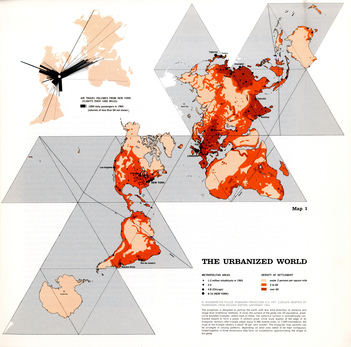
In what sense is the 21st century world urban? In this lecture, Neil Brenner critiques contemporary ideologies of the "urban age," which confront this question with reference to the purported fact that more than 50% of the world's population resides within cities. Against such demographic, city-centric understandings, Brenner excavates Henri Lefebvre's (1970) notion of generalized urbanization for conceptual and methodological insights into the 21st century planetary urban condition. He argues that the geographies of urbanization can no longer be conceptualized with reference to cities, metropolitan regions or even megalopolises, but today encompass diverse patterns and pathways across the planetary sociospatial landscape, from Manhattan to the Matterhorn, from the Pearl River Delta to Mount Everest, from the Nile River valley to the Pacific Ocean. This variegated urban fabric must become the focal point for new approaches to urban theory, strategies of collective intervention and imaginaries of built environments.
Neil Brenner is Professor of Urban Theory at the Harvard Graduate School of Design (GSD) and the coordinator of the newly founded Urban Theory Lab GSD. He previously served as Professor of Sociology and Metropolitan Studies, and as an affiliated faculty member of the American Studies Program at New York University. He holds a Ph.D. in Political Science from the University of Chicago (1999); an MA in Geography from UCLA (1996); and a BA in Philosophy from Yale College (1991).
This talk is co-presented by the Chicago Expander at Archeworks and the Graham Foundation.
The Chicago Expander at Archeworks aims to spatialize the formation of Chicago as a larger geographic entity and recasts the city and its region as a spatial model. The program is directed by Iker Gil and Antonio Petrov.
Archeworks is a multidisciplinary design educator that advances design in the public interest and inspires collaborative action to shape more healthy, sustainable and equitable communities.

Copyright © 2008–2026 Graham Foundation. All rights reserved.