Saturday Gallery Walkthrough
Feb 04, 2023 - Feb 25, 2023
(2pm)
Free admission, reservations required
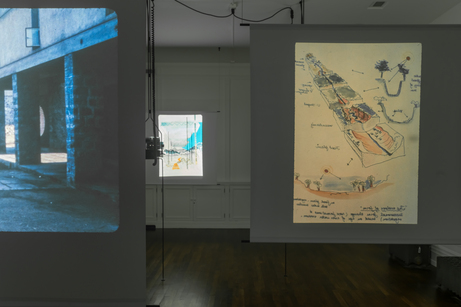
Join us for an introduction to the exhibitions currently on view, Pidgeon Audio Visual: Architects Speak for Themselves and Barbara Stauffacher Solomon: Exits Exist, led by Graham Foundation staff.
Walkthroughs run from 2:00–2:30 on the following dates:
Saturday, Feb 4
Saturday, Feb 11
Saturday, Feb 18
Saturday, Feb 25
Group tours are available by request, contact us at info@grahamfoundation.org
For more information on the exhibition, Pidgeon Audio Visual: Architects Speak for Themselves, click here.

Silvia Tarozzi and Deborah Walker
Lampo Performance Series
Dec 03, 2022
(4pm)
Reservations required; limited capacity SOLD OUT
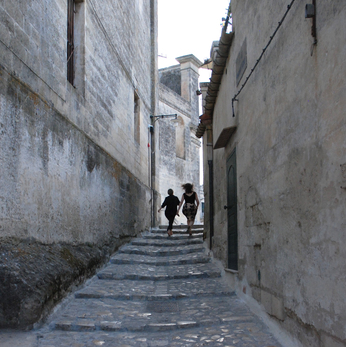
Silvia Tarozzi and Deborah Walker perform the United States premiere of Canti di guerra, di lavoro e d’amore, a transcription and reinterpretation of Italian folksongs from their birthplace, the rural Emilia-Romagna region, for violin, cello, and voice.
Tarozzi and Walker reflect, "These songs come from the first decades of the twentieth century and from the period of World War II, but some of them have older roots. The melodies and especially the lyrics have been transformed over time through oral transmission and adapted to different social, working, and historical contexts. One of the strongest influences of our project is the repertory of songs sung by choirs of female rice field workers, called the Mondine."
Since 2010 the Graham Foundation has partnered with Lampo to produce an international performance series held at the Madlener House. Lampo, founded in 1997, is a nonprofit organization for experimental music and intermedia projects.
Note that seating for this performance is very limited. Reservations are required for entry, link to register via eventbrite coming soon. If you make a reservation and then are no longer able to attend, please cancel your reservation through Eventbrite or email info@grahamfoundation.org to release the spot to someone on the waiting list.
Silvia Tarozzi (b.1975, Bologna, Italy) and Deborah Walker (b.1981, Reggio Emilia, Italy) share a friendship that has evolved into a 20-year artistic partnership. Their music is characterized by a profound interplay, a focus on the acoustic qualities of their instruments, and the search for new possibilities in tunings, gestures, and sound. Together they have explored different musical forms and have worked in several varied projects, including Ensemble Dedalus, a contemporary music ensemble based in Montpellier, France, and Italian art pop band, Offlaga Disco Pax. Their long collaboration with composers Éliane Radigue, Pascale Criton, and Philip Corner have led to the creation of numerous new works. The duo has played at many international venues and festivals, including Huddersfield Contemporary Music Festival, Huddersfield, England; Fondation Cartier, Paris; Biennale Musica, Venezia; Angelica Festival, Bologna; Festival Musique Action, Nancy, France; Festival Futurs Composés, Paris; Fast Forward, Teatro Dell'Opera Di Roma, Rome; Tectonics, Glasgow; and Café Oto, London. Their recordings have been released on Potlatch and Unseen Worlds.
Lampo, established in 1997, supports artists working in new music, experimental sound, and other interdisciplinary practices. The Chicago-based organization's core activity has been and remains its performance series. Rather than making programming decisions around tour schedules, Lampo invites selected artists to create and perform new work, and then the organization provides the space, resources, and curatorial support to help them fulfill their vision. Lampo also organizes artist talks, lectures, screenings, and workshops, and publishes written and recorded documents related to its series.
Lampo gratefully acknowledges additional support provided by the Italian Cultural Institute of Chicago.
Cyberfeminism Index
Mindy Seu with Lee Blalock
Nov 17, 2022
(6pm)
Book Launch
RSVP required
Join us for a performative lecture and discussion to launch the Cyberfeminism Index. Seu will be joined in conversation with artist Lee Blalock. Edited by designer, professor, and researcher Mindy Seu, Cyberfeminism Index gathers more than 700 short entries of radical techno-critical activism, feminist manifestos, hackerspaces, hardware, and wetware education and net art from 1991 to 2020, starting with an excerpt from Donna Haraway’s seminal essay “A Cyborg Manifesto.” Its online complement, cyberfeminismindex.com (2020), is a living, online index that was commissioned by Rhizome and premiered with New Museum. Its print form, published by Inventory Press, was supported by a Graham Foundation grant in 2021.
ABOUT CYBERFEMINISM INDEX
In Cyberfeminism Index, hackers, scholars, artists, and activists of all regions, races, and sexual orientations consider how humans might reconstruct themselves by way of technology. When learning about internet history, we are taught to focus on engineering, the military-industrial complex, and the grandfathers who created the architecture and protocol, but the internet is not only a network of cables, servers, and computers. It is an environment that shapes and is shaped by its inhabitants and their use.
The creation and use of the Cyberfeminism Index is a social and political act. It takes the name cyberfeminism as an umbrella, complicates it, and pushes it into plain sight. Edited by designer, professor, and researcher Mindy Seu, it includes more than 700 short entries of radical techno-critical activism in a variety of media, including excerpts from academic articles and scholarly texts; descriptions of hackerspaces, digital rights activist groups, and bio-hacktivism; and depictions of feminist net art and new media art.
Both a vital introduction for laypeople and a robust resource guide for educators, Cyberfeminism Index—an anti-canon, of sorts—celebrates the multiplicity of practices that fall under this imperfect categorization and makes visible cyberfeminism’s long-ignored origins and its expansive legacy.
Advance copies will be available for purchase in the Graham Foundation bookshop during the event. Pre-order copies are available now on inventorypress.com. Follow the international Cyberfeminism Index book launch tour on tour.cyberfeminismindex.com
Mindy Seu (b. 1991, California) gathers the histories of technology to analyze and inform contemporary society. Trained as a graphic designer, she works collaboratively across the disciplines of design, art, and technology to document overlooked voices. These projects are expressed in a variety of forms, from archival projects and techno-critical writing to performative lectures and resource sharing. Seu’s ongoing Cyberfeminism Index (cyberfeminismindex.com), which gathers three decades of online activism and net art from 1991 to the present, was commissioned by Rhizome and presented at the New Museum in its online form. Its print form, published by Inventory Press, is a recipient of a Graham Foundation grant. Her work is both technological and interdisciplinary, marking the ways that online environments intersect with issues of race, gender, culture, and power. She is regularly invited to present on alternative archival projects and contemporary feminism by cultural institutions (Barbican Centre, New Museum), academic institutions (Columbia University, Central Saint Martins), and mainstream platforms (Google, Pornhub, SSENSE). Seu has been a resident at MacDowell, Sitterwerk Foundation, Pioneer Works, and Internet Archive, and holds an M.Des. from Harvard University Graduate School of Design and a bachelor of arts in design media arts from the University of California, Los Angeles. She is currently assistant professor at Rutgers Mason Gross School of the Arts and critic at Yale School of Art.
Lee Blalock is a Chicago-based artist and educator presenting alternative and hyphenated states of being through technology-mediated processes. Interested in how technologies support the idea of impossible anatomies, behaviors, and performances, her work is an exercise in body modification by way of amplified behavior or "change-of-state". Lee’s interests include embodied cognition, anatomy and biomechanics, bionics, mechatronics, human/non-human entanglement, and computational abstraction. She has presented work domestically, internationally, and virtually at many institutions including Ars Electronica, the wrong biennale, NYU Abu Dhabi Art Gallery, Experimental Sound Studio (Chicago), ICA (Philadelphia), 205 Hudson Gallery (NY), and the Art Institute of Chicago. Lee is an Assistant Professor in the Art and Technology Studies Department at the School of the Art Institute of Chicago and practices various forms of embodiment as an everyday athlete.
Cyberfeminism Index is published by Inventory Press and distributed by Distributed Art Publishers and funded by the Graham Foundation, Rhizome, and Feral File, and is made possible in part by the Rutgers University Research Council, Pratt Institute, Pioneer Works, and Cita Press.
Related Graham Foundation supported projects:
2021 grant to Mindy Seu for the publication Cyberfeminism Catalog
Chicago Design Summit: The Future Real Conditional
Chicago Architecture Biennial
Nov 05, 2022
(10:30am)
Panel Discussion
Reservations required; limited capacity
The Graham Foundation is pleased to partner with the Chicago Architecture Biennial to host the Chicago Design Summit, led by the Floating Museum—artistic team for CAB 5, the fifth edition of the Chicago Architecture Biennial, This is a Rehearsal, opening September 2023. The Summit convenes leading practitioners to explore emerging ideas in contemporary architecture and design and serves as a forum for research and the development of the CAB 5 program.
Introduction by the Floating Museum
10:30 a.m.
Session 1: Rehearsing Critique
11 a.m.–12:30 p.m.
This panel explores rehearsal as a practice of systemic and structural critique—living with and within systems to identify what has been overlooked, unconsidered, and uninvestigated—to establish a duty and standard of care as a prerequisite to performative, political, organizational, or environmental engagements or actions.
Panelists: Ionit Behar, associate curator, DePaul Art Museum (Chicago); Andrea Carlson, artist (Chicago); Ibrahim Mahama, artist (Tamale, Ghana); Anjulie Rao, journalist (Chicago); Florencia Rodriguez, director, School of Architecture at the University of Illinois Chicago (Chicago)
Facilitator: Kerry Cardoza, journalist (Chicago)
Lunch Break
12:30–1:30 p.m.
Session 2: Rehearsing Relations
1:30–3 p.m.
This panel explores rehearsal as a practice of individual and collective attunement to build organizational power through mutual understanding.
Panelists: Jha D Amazi, director of the Public Memory and Memorials Lab, principal, MASS. (Boston); Skyla Hearn, cofounder, The Blackivists (Chicago); Erin Harkey, commissioner, Department of Cultural Events and Special Affairs (Chicago); Asad Jafri, cultural producer/artist (Chicago); Ujijji Davis Williams, landscape architect, founder, JIMA Studio (Detroit)
Facilitator: Megha Ralapati, program director, fellowships, CEC ArtsLink (Chicago)
Session 3: Rehearsing Production
3:15–4:45 p.m.
This panel explores rehearsal as a practice of production through improvisation, speculation, and iterative development in response to social and climatic change.
Panelists: Meida Teresa McNeal, artistic/managing director, Honey Pot Performance (Chicago); Dan Peterman, artist, founder, Experimental Station (Chicago); Vyjayanthi Venuturupalli Rao, anthropologist (New York); Chris Reed, landscape architect, founding principal, STOSS (Cambridge); Feda Wardak, architect, director, Aman Iwan (Paris)
Facilitators: Karla Sierralta and Brian Strawn, cofounders, Strawn Sierralta (Honolulu)
Closing performance and reception
5 p.m.
The Summit is made possible with support from the National Endowment for the Arts and Graham Foundation.
Click here to learn more about the Chicago Architecture Biennial
Gallery and Bookshop Hours
Oct 29, 2022 - Feb 25, 2023
Reservations required; free admission
Through February 25, 2023
Gallery and Bookshop Hours
Wednesday–Saturday, 12–5 p.m.
On view: Pidgeon Audio Visual: Architects Speak for Themselves and Barbara Stauffacher Solomon: Exits Exist
For gallery hours and timed-entry reservations, click here to book on tock.com/grahamfoundation
Visitor Guidelines
Please note: The audio component of the Pidgeon Audio Visual installation is only accessible to stream in the galleries through the exhibition's dedicated website on a mobile device. The use of a personal mobile device is encouraged and headphones are required. Headphones and chargers are available for use as needed.
The first-floor galleries and bookshop are accessible via outdoor lift. Please call ahead to make arrangements. The second-floor galleries and the third-floor ballroom, where events are held, are only accessible by stairs.
Group tours available by request
For more information on the exhibition, Pidgeon Audio Visual: Architects Speak for Themselves, click here.



 PREVIOUS POSTS