-
upcoming events
David Behrman & Cleek Schrey Lampo Performance Series Nov 07, 2026 Performance
FORCE! an opera in three acts Anna Martine Whitehead Nov 12, 2026 Book Launch
Henry Fraser Lampo Performance Series Dec 05, 2026 Performance
-
past events
Josephine’s Sharmyn Cruz Rivera and Daniel Giles Oct 16, 2026 Talk

Madlener House
4 West Burton Place
Chicago, Illinois 60610
Telephone: 312.787.4071
info@grahamfoundation.org
Warp Duo
Lampo Performance Series
Sep 26, 2026
(7pm)
Performance
RSVP required, limited capacity
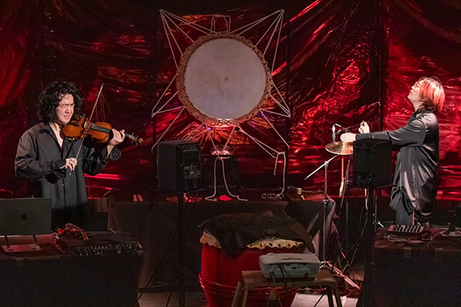
In Cradled Current, Warp Duo develops feedback as a shared instrumental language. Qiujiang Levi Lu and Scott Congyu Li perform on new systems that have emerged through their five-year collaboration, bringing their individual practices into closer contact.
Li uses a transducer-based system that feeds the amplified signal of their violin back through the body of the instrument. Bowing, plucking, muting, and physical contact with the violin alter the resulting sound, moving between resonant drones, unstable noise, and conventional string articulation. Lu performs with an intraoral speaker and feedback trombone routed through a joystick-controlled processing system. The processed signal returns through the speaker in Lu’s mouth, creating a recursive circuit between the body and electronic processing.
Warp Duo’s Cradled Current, created for Lampo, brings the two systems into a single environment—electrical and volatile, but also, as the title suggests, something held and carried between the two performers. The largely improvised work extends material from the duo’s earlier 沿光苍穹 / The Ever-Reaching, Luminescent Horizon.
Warp Duo is the queer Chinese American duo of Qiujiang Levi Lu and Scott Congyu Li. Using violin, trombone, voice, guitar, and live electronics, they combine free improvisation, electronic processing, and songs influenced by Chinese folk lullabies. Their work explores love, grief, fragility, intimacy, and human connection.
Scott Congyu Li (b. 1998, Princeton, N.J.) is a New York-based violinist, composer, producer, improviser, filmmaker, and electroacoustic sound artist. Their work combines string playing with modular synthesis, live processing, fixed media, film, photography, dance, and poetry.
Li has collaborated with musicians, filmmakers, visual artists, poets, and dancers, with projects ranging from pop production to experimental noise music. Their work has been presented by New World Symphony’s BLUE Project series, Miami; the University of Michigan Department of Dance, Ann Arbor, Mich.; and Pathos Trio. Performances include Park Avenue Armory, The Jazz Gallery, and Dripping, New York; Big Ears Festival, Knoxville, Tenn.; New World Center, Miami Beach, Fla.; REDCAT, Los Angeles; Rhizome DC, Washington, D.C.; A L’ARME! Festival, Berlin; and Cologne Jazzweek, Cologne, Germany, among others. Li is a recording engineer at the Juilliard School.
Qiujiang Levi Lu (b. 1999, Beijing) is an experimental musician, composer, creative technologist, and educator. They work across live performance, electroacoustic instrument design, installation, composition, film scoring, and multimedia collaboration. Lu builds electroacoustic instruments including intraoral microphone-speaker feedback systems, amplified laptop interfaces, and motion-sensing electronics. Their work brings Chinese musical lineages into conversation with noise, embodied technology, queerness, spirituality, and transformation.
Performances include La MaMa and MATA Festival, New York; Send + Receive, Winnipeg; High Zero Festival, Baltimore; IRCAM Forum, Paris; Threading Festival, Taipei; and Temple Dongjingyuan, Beijing, among others. Lu has been an artist-in-residence at Issue Project Room, Brooklyn; Harvestworks and The New School, New York; Wave Farm, Acra, N.Y.; and Elektronmusikstudion, Stockholm. They have received commissions from TAK Ensemble, Popebama, and Luke Helker, and support from the Foundation for Contemporary Arts Emergency Grants program, Ernst & Young Emergent Futures Fellowship, and NEW INC.
Lu is a lecturer in music at the University of Pennsylvania and Peabody Conservatory at Johns Hopkins University.
Lampo, established in 1997, supports artists working in new music, experimental sound, and other interdisciplinary practices. The Chicago-based organization's core activity has been and remains its performance series. Rather than making programming decisions around tour schedules, Lampo invites selected artists to create and perform new work, and then the organization provides the space, resources, and curatorial support to help them fulfill their vision. Lampo also organizes artist talks, lectures, screenings, and workshops, and publishes written and recorded documents related to its series.
Accessibility: This event will be held in the ballroom on the third floor of the Madlener House, which is only accessible by stairs. The first-floor galleries and bookshop are accessible via outdoor lift. Please contact us at 312.787.4071 or info@grahamfoundation.org to make arrangements.
Note: Registration for Lampo programs is required, but does not guarantee entry. Capacity for this performance is limited. Doors open 30 minutes prior to the performance and seats are available on a first-come, first-serve basis for those registered in advance. Reservations expire 5 minutes before the performance start time, at which point seating will be released to the waitlist. Due to the popularity of the Lampo programs, performances quickly reach capacity. No late seating will be permitted.
Photo: RoBotEaters

Copyright © 2008–2026 Graham Foundation. All rights reserved.