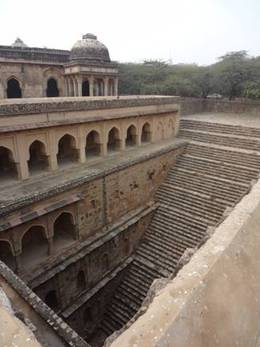
Rajon ki Baoli, Rajasthan, India.© Victoria Lautman.
Subterranean Ghosts: India's Vanishing Stepwells
Victoria Lautman
Nov 04, 2013
(6pm)
Talk
Please RSVP
Stepwells are a form of architecture unique to South Asia that first appeared in rudimentary form in India between the 2nd and 4th centuries A.D. Sunk deep into the earth, these underground edifices not only harvested and preserved water, but also functioned as civic centers, temples, cool retreats, and caravan stops. However, as many stepwells have been barricaded, filled in, repurposed, or altogether destroyed, they are quickly disappearing from historic record.
Journalist Victoria Lautman is a frequent traveler to India and former contributing editor for Architectural Record, Metropolitan Home, HG, Art+Auction, and Chicago magazine. In India, she’s written for The Hindu, Architectural Digest, Vogue, and GQ. Her writing about India has also appeared in Town & Country, ArchDaily.com, and The Huffington Post. Lautman’s long-running radio programs were heard on WFMT and WBEZ.
This talk is co-sponsored by AIA Chicago and Society of Architectural Historians.
Related Links
Society of Architectural Historians
http://www.sah.org/conferences-and-programs/events-and-opportunities/2013/09/25/subterranean-ghosts-india-s-vanishing-stepwells
AIA Chicago
http://www.aiachicago.org/events.asp#November2013

Mark Fell
LAMPO PERFORMANCE SERIES
Nov 02, 2013
(8pm)
Performance
Please RSVP
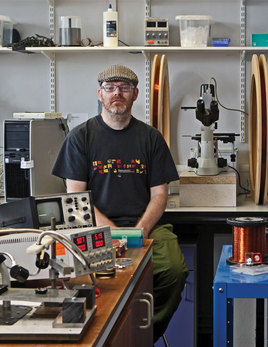
In his Chicago solo debut, Mark Fell presents new tonal work from music he developed as guest composer at the historic Elektronmusikstudion in Stockholm.
Fell is widely known for combining popular music styles, such as electronica and techno, with more academic approaches to computer-based composition that draw on algorithmic and mathematical systems. His recent musical practice is increasingly informed by non-European musics, evident in two linked works, Multistability and UL8, which explore a number of unfamiliar timing and tuning systems. In addition to recorded works, Fell produces installation pieces, often using multiple speaker systems. Although well versed in the use of ambisonics, his work in this area is characterized by “non-illusion based” approaches, where multiple wave shapes are spatially distributed to form complex synthetic sonic environments.
Mark Fell (b. 1966, Rotherham, England) is a multidisciplinary artist based in Sheffield, England. After studying experimental film and video art at Sheffield City Polytechnic, he reverted to earlier interests in computational technology, music, and synthetic sound. In 1998 he initiated a series of critically acclaimed collaborative and solo record releases on labels including Mille Plateaux, Line, Editions Mego, Raster Noton, and Alku. Fell received an honorary mention in the digital music category at Prix ARS Electronica (Linz) and was shortlisted for the Quartz award for his contribution to research in digital music. He has also been involved in several academic research projects, including a 2003 project led by British Algorist Ernest Edmonds at Loughborough University in the UK which explored the philosophy of technology in relation to contemporary art.
This performance is presented in partnership with Lampo. Founded in 1997, Lampo is a non-profit organization for experimental music, sound art, and intermedia projects. Visit www.lampo.org.
Looking Back to See Ahead: Emilio Ambasz, Mark Wasiuta, and The New Domestic Landscape
Oct 31, 2013
(6pm)
Talk
Please RSVP
The Graham Foundation is pleased to welcome architect and designer Emilio Ambasz, curator of MoMA’s groundbreaking 1972 exhibition Italy: The New Domestic Landscape, and Mark Wasiuta, co-curator of the Graham’s current exhibition Environments and Counter-Environments, for a talk on October 31, 2013. Following an introduction by Mark Wasiuta, Emilio Ambasz will read two texts that critically reflect on the historic 1972 exhibition.
Emilio Ambasz is an Argentinean architect and designer. He received his Bachelor and Master of Architecture degrees from Princeton University. From 1969 to 1976, Ambasz was Curator of Design at the Museum of Modern Art in New York, where he developed numerous influential exhibitions on architecture and design. Ambasz’s architectural projects, which explore the poetic potential and public value of natural landscapes, include the San Antonio Botanical Conservatory (1988), the ACROS Fukuoka Prefectural International Hall (1994), and the Banca dell’Occhio in Mestre-Venice, Italy (2009).
Mark Wasiuta teaches at the Graduate School of Architecture Planning and Preservation, Columbia University where he is the Director of Exhibitions and Co-Director of the Masters of Science in Critical, Curatorial and Conceptual Practices in Architecture (CCCP). He studied at the University of British Columbia, Princeton University, and Harvard University. His research focuses on postwar environmental design, an area of shared interest at the base of his collaborative office, the International House of Architecture. He is the recipient of recent grants from the Graham Foundation, the Canadian Social Sciences and Humanities Research Council, and the Banff New Media Institute. Recent curated and designed exhibitions include, Tony Oursler, UFOs and Effigies, No Longer Art: Salvage Art Institute, Collecting Architecture Territories, and Operators’ Exercises: Open Form in Film and Architecture. He is co-editor and co-author of Dan Graham’s New Jersey, and has recent articles published in Domus, Art Lies, Praxis, Journal of the Society of Architectural Historians, and Explorations.
For more information on the exhibition, Environments and Counter Environments. “Italy The New Domestic Landscape,” MoMA, 1972, click here.
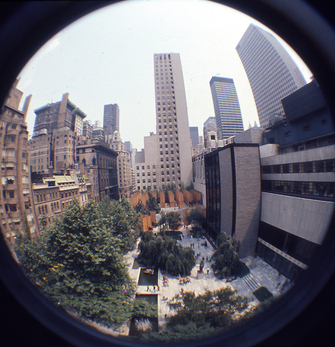
Image: Italy: The New Domestic Landscape, 1972. Photograph by Cristiano Toraldo di Francia, courtesy of Emilio Ambasz.
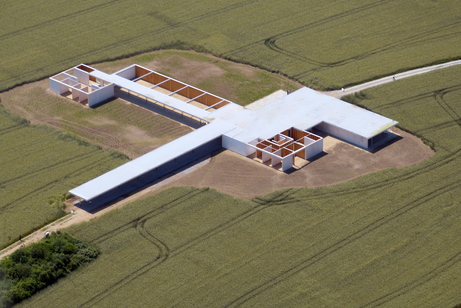
MIES 1:1 Das Golfclub Projekt © Frank Werthebach, 2013
Mies in Krefeld: The Golf Club Project. The Model as S(t)imulation, Visualization and Prototype
Oct 23, 2013
(6pm)
Panel Discussion
Please RSVP
In 1930, Mies van der Rohe, at the height of his European career, designed a golf clubhouse on the outskirts of Krefeld, Germany. While Mies’s design was never realized, this year Belgian architects Robbrecht en Daem and the Mies in Krefeld (MIK) Society constructed MIES 1:1 The Golf Club Project—a full-scale model of the clubhouse at the originally planned site in Krefeld. Based on sketches and plans from MoMA’s Mies van der Rohe Archives, MIES 1:1 was conceived as a site of investigation into Mies’s legacy and architectural language, his work in Krefeld, and the idea of the “model” in architecture and art.
On October 23, project curator Christiane Lange, architect and artistic director Paul Robbrecht, and curator Julian Heynen will give a series of related presentations about MIES 1:1. Lange will explore the historical background of Mies’s original design and the various meanings and public reception of the 1:1 model. Robbrecht will discuss his approach to the model’s source materials and how he approximated the 80-year-old designs. Lastly, Heynen will situate the 1:1 model within the broader context of architectural and artistic strategies.
Julian Heynen studied art history and literature and is currently Artistic Director at Large of the Kunstsammlung Nordrhein-Westfalen, Düsseldorf. He was co-curator of the Shanghai Biennale in 2008 and commissioner of the German Pavilion at the Venice Biennale in 2003 and 2005. In the 1980s and 1990s he was Director of Exhibitions at Kunstmuseen Krefeld, curating many shows of contemporary art at Haus Lange and Haus Esters, two villas designed by Ludwig Mies van der Rohe in 1927-1930. Heynen has curated numerous exhibitions of the works of artists including: Bruce Nauman, Thomas Schütte, Franz West, Andreas Gursky, Juan Muñoz, Richard Deacon, Thomas Struth, Lothar Baumgarten, Luc Tuymans, Rosemarie Trockel, Stan Douglas, Thomas Ruff, Daniel Richter, Rodney Graham, Candida Höfer, Martin Kippenberger, and Roman Ondák, as well as many group exhibitions. He has written widely on contemporary art since the 1960s. Heynen is based in Düsseldorf and Berlin.
Christiane Lange holds master’s degrees in art history and history from the universities at Bonn and Regensburg. She is a founding member of “projektMIK,” Krefeld, Germany. Her research, exhibitions and films focus on the European work of Mies van der Rohe and Lilly Reich.As a member of the German Research Foundation, Lange catalogs all furniture designs, realized and un-realized, by Ludwig Mies van der Rohe. Lange’s most recent publication is titled Mies van der Rohe, Bauten für die Seidenindustrie (Berlin, 2011).
Paul Robbrecht received his degree in architecture at HSLI, Ghent in 1974. In 1975 he co-founded Robbrecht en Daem architecten with Hilde Daem. Since 1992 he has been Professor of Architectural Design at HSLI, Ghent. Robbrecht is a member of the Royal Flemish Academy of Belgium for Science and the Arts and an International Fellow of Royal Academy of British Architecture (RIBA). Robbrecht and Daem were finalists for the 2013 European Union Prize for Contemporary Architecture / Mies van der Rohe Award for their project Market Hall - Reconstruction Korenmarkt, E. Braunplein and surroundings, Ghent.
This event is presented in partnership with the Goethe-Institut Chicago and the Mies van der Rohe Society at the Illinois Institute of Technology.
Related Links
Projekt Mies in Krefeld
http://www.projektmik.com/
Robbrecht en Daem
http://www.robbrechtendaem.com/
Open House Chicago
Oct 19, 2013 - Oct 20, 2013
(9am)
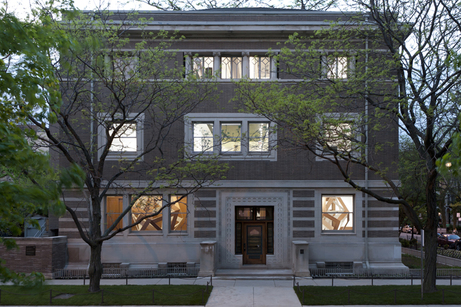
The Graham Foundation is pleased to be part of Open House Chicago, a free public event organized by the Chicago Architecture Foundation that offers behind-the-scenes access to 150 buildings across Chicago. Since 1963 the Graham Foundation has been located in the Madlener House, a Prairie-style mansion built in 1901–02 by architect Richard E. Schmidt and designer Hugh M. G. Garden. The Madlener House was restored in 1963 to become the Graham’s headquarters and features two floors of exhibition space, original art glass windows, and a courtyard garden that showcases our significant collection of late nineteenth- and early twentieth-century architectural fragments. On Saturday and Sunday, October 19–20 from 9am–5pm, come tour the Madlener House, visit our current exhibition Environments and Counter Environments. “Italy: The New Domestic Landscape,” MoMA, 1972¸ and check out our new architecture bookshop conceived by Chicago-based designer Ania Jaworska.
Image: View of “Anne Tyng: Inhabiting Geometry,” 2011, Graham Foundation, Chicago. Photo James Prinz.
For more information on the exhibition, Environments and Counter Environments. "Italy: The New Domestic Landscape,” MoMA, 1972, click here.

 PREVIOUS POSTS